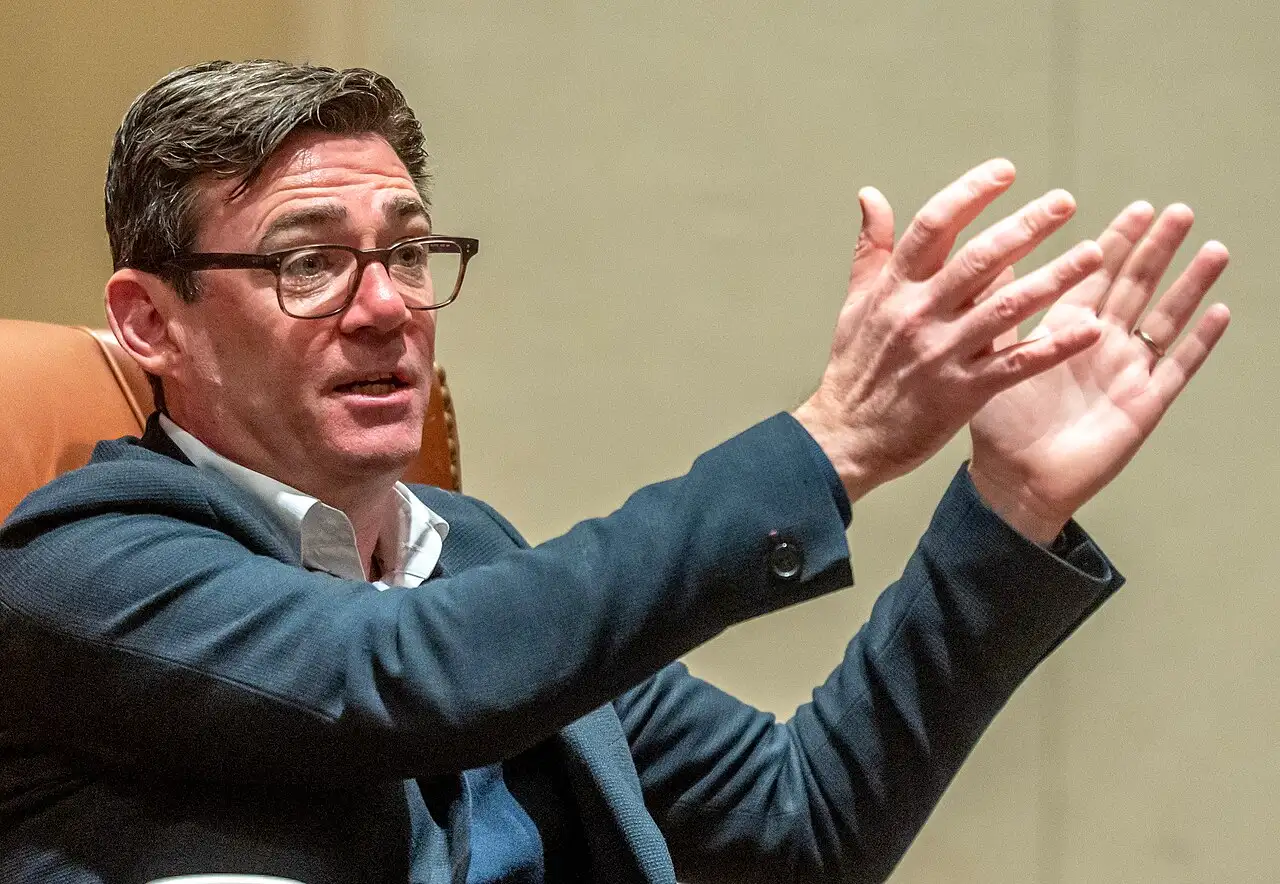
Zohran Mamdani’s victory has thrilled the American left. But his pledge to remake New York through socialist ideals risks repeating the same old experiment — one that has failed everywhere it’s been tried, writes Harry Margulies
Many people today feel like financial outsiders. Young people especially sense they have no future. A degree no longer guarantees a place in the middle class, and the promise of steady progress has evaporated. Faced with that bleak reality, some are drawn to old ideas dressed in new clothes — socialism, even communism — as if these might offer rescue.
In New York, the city’s new mayor, Zohran Mamdani, has begun flirting with those ideas. Mamdani promises what communists have always promised: cheap housing, free transport, free everything, and “justice for all”. It sounds noble. Yet when government decides to run grocery stores in competition with private ones, the results are rarely heroic. Free goods for the poor, paid for by the rich, remain a seductive illusion — until the rich decide to leave. Raise taxes too high and the money follows. New York State’s tax-free development zones exist for precisely that reason: capital is mobile.
Consider a simple analogy. Five people meet for lunch each day. One, who is rich, pays half the bill. Another, upper-middle class, pays 30 per cent. Two more, lower-middle class, pay 10 each. One pays nothing. One day, the two in the middle decide they’re no better off than the one who pays nothing and vote, with the poorest, to stop contributing. The rich man is told to pay 70 per cent. He stops showing up. So much for equity.
There is no such thing as “free”. It only means someone else is footing the bill — until that someone objects or moves away. The mayor’s programme will be an experiment not just for New York, but for the Democratic Party itself. If it fails, the party may carry the blame.
Even Karl Marx acknowledged that communism ran counter to human nature, which is why he proposed a “dictatorship of the proletariat” to enforce it. What could possibly go wrong? Perhaps the wiser course is to reject any system that requires a dictator to make it work.
People want to get ahead, to do better than their neighbours. I have known those who once championed communism when they had little, only to abandon it once they had more than they expected.
I saw how it really functioned. At sixteen, living in Sweden, I visited communist Poland. I smuggled in nylon shirts and stockings — prized on the black market — and sold them for more than a Polish miner earned in a year. Everything Western was coveted. When my Swedish shoes wore out and I bought a local pair, someone offered four times their price, assuming they were imported.
Store shelves were bare unless you belonged to the Party. Members shopped in special stores and travelled in limousines. Ordinary citizens stepped aside as they passed. Those with relatives abroad who sent dollars could buy in well-stocked “hard currency” shops; the rest queued for hours for basics. Grandmothers spent whole days waiting for two oranges. If a queue formed, people joined it automatically — whatever was at the end must be worth it.
Under communism, everything became capitalist, but under the table. I once bribed an ambulance driver to take me to my hotel. On another occasion, I paid a bus driver to skip his route and drive me privately, even with seventeen passengers still aboard. No one protested; they understood that their turn would come. In the West, both men would have been dismissed.
Two years later, on a flight from Warsaw to Stettin, I sat beside a district judge who spent three days a week trading Swedish kronor on the black market. I had run out of Western currency, so I helped him — for a fee.
In my late twenties I worked with a Swedish firm subcontracting on the Pribaltiyskaya Hotel in Leningrad. The hotel was magnificent. The surrounding apartment blocks, however, were crumbling. If a wall went crooked, the bricklayers simply laid a new row and carried on. Nobody cared.
The Soviet elite exempted themselves from “equality”, hoarding fortunes in secret accounts. The Castro brothers, idolised by some in the West, did the same. Orwell captured it best in Animal Farm: “The creatures outside looked from pig to man, and from man to pig, and from pig to man again; but already it was impossible to say which was which.”
When I returned to St Petersburg after the collapse of communism, the Swedish hotel still gleamed; the Soviet housing around it had decayed into grey, crumbling boxes. Soviet workers had a saying: They pretend to pay us, and we pretend to work.
No communist state has ever caught up with capitalist ones. Consider Tomáš Baťa, the Czech shoemaker whose factories were seized by the communists. From exile in Canada, he built a global empire. When the regime later invited him to reinvest in his old plant, he declined. His brand had outgrown it.
That is the power of capitalism: compete or be left behind.
Some now point to China as proof that communism can succeed. Yet China today is a capitalist economy under one-party rule that still calls itself communist. The name remains, but the substance is long gone.
Mamdani may soon learn that lesson himself. However high-minded his ideals, they will collide with reality the moment the city’s wealth starts moving elsewhere. Good intentions cannot outrun human nature. In New York, as everywhere, someone must still pick up the bill.

Harry Margulies is a journalist, author, commentator, and public intellectual whose work interrogates religion, politics, and morality with sharp wit and fearless clarity. A second-generation Holocaust survivor, he was born in Austria and spent time in an Austrian refugee camp before moving to Sweden. Educated by Orthodox rabbis throughout his childhood, he ultimately abandoned faith in his teens—a journey that has shaped his lifelong commitment to secularism, critical thinking, and freedom of expression. His latest book, Is God Real? Hell Knows, has been described by ABBA’s Björn Ulvaeus as “funny, sharp, and unafraid.”
READ MORE: ‘Why the pursuit of fair taxation makes us poorer‘. Everyone claims to want a fairer society, yet few can define what ‘fairness’ means. In the first in a series on equity, taxation, and growth, our Business and Regulation correspondent Harry Margulies asks whether a moral ideal can ever be written into economic law — and what happens when societies try.
Do you have news to share or expertise to contribute? The European welcomes insights from business leaders and sector specialists. Get in touch with our editorial team to find out more.
Main image: Credit, Bingjiefu He / Wikimedia Commons (CC BY-SA 4.0)