As workweeks grow more demanding and stress levels soar, professionals are increasingly snubbing the conventional post-work drink and turning to a more relaxing – alcohol-free – alternative: mantra lounges. These serene spaces fuse ancient practices with modern-day chill, offering a refreshing, hangover-free alternative to the noisy, high-energy environments typically associated with unwinding after a long week, writes our health and wellbeing correspondent, Andrew Horn
For the uninitiated, mantra lounges are not your typical wellness spots. Unlike traditional yoga studios and meditation centres, which can feel intimidating to newcomers (and let’s face it, elitist and pretentious, too), mantra lounges are unique in the sense that they actively prioritise diversity and inclusivity. In any one lounge, you’ll find people of all ages and walks of life—corporate workers, creative professionals, students, and pensioners—unwinding together, united by a common desire for peace and connection. Or to put it another way, you’re as likely to meet a Tesla driver in a pin-stripe suit as you are a hippie with a tie dye T-shirt and CND medallion.
It is perhaps no surprise that, thanks to their open-doors policy and welcoming, non-judgemental environment, mantra lounges are more popular than ever in towns and cities across the world, often as pop-up events. Many regulars report them to be a necessary antidote to the pressures of modern life. With global stress and anxiety levels at all-time highs, professionals are recognizing the importance of mental health and community-driven spaces that promote healing. Mantra lounges, with their blend of mindfulness, spirituality, and relaxation, are a haven where folk can pop in for a breather and unwind, decompress, and be themselves. With soft lighting, comfortable seating, and calming décor, they’re purposefully designed to foster a meditative atmosphere conducive to introspection and inner peace.
The social aspect is a significant draw. Unlike traditional meditation centres where silence is the norm, mantra lounges encourage a sense of community. After chanting or meditation, visitors can sit together, sipping herbal teas, talking about their experiences, or simply lounging in a relaxed, nonjudgmental atmosphere. This communal element makes it easy to integrate the mystical into the everyday, without the rigidity that often accompanies spiritual practices, thereby transcending boundaries of religion, background, or belief, and offering a shared experience that brings people together.
At the heart of many mantra lounges is the famous Hare Krishna chant: “Hare Krishna, Hare Krishna, Krishna Krishna, Hare Hare; Hare Rama, Hare Rama, Rama Rama, Hare Hare”. This ancient mantra, rich with spiritual significance, is traditionally believed to invoke divine energy and bring the chanter closer to inner peace and self-realisation. Yet in the mantra lounge, it’s not confined to religious settings or ceremonial gatherings.
Instead, the Hare Krishna chant—and others like it—flows freely through these spaces, welcoming anyone, regardless of their spiritual beliefs. The relaxed, non-ritualistic atmosphere allows participants to engage with the chanting on their own terms. For some, it’s a deeply meditative experience. For others, it’s simply a soothing background sound that helps them unwind. This universality is part of the mantra lounge’s appeal.
“I come here after a long day at work,” Rasal Hammond, an IT manager, told me. I met him and others at OmNom, a restaurant in London that doubles as a mantra lounge every Friday evening. “I don’t necessarily chant every time, but just being in the space, hearing the mantras, and being around people who are also trying to find balance makes me feel grounded. It’s like a little oasis.”
Another visitor, Francis Grappa, a resident of New York and regular attendee of a mantra lounge in the Big Apple, added: “When we chant together, it doesn’t matter where you’re from or what you believe. We’re all part of the same vibration, the same energy.”
“There’s something about the mantra lounge that brings me into the present moment,” explained Shari Mcnamara, a regular at another of London’s most popular lounges. “I used to feel awkward about chanting, but here, surrounded by others seeking peace, it feels natural.”
But while the spiritual and communal aspects of mantra lounges appear to be undeniable, their benefits are also grounded in science. Research from the University of Massachusetts shows that mindfulness meditation, including mantra techniques, can significantly reduce stress and anxiety. Employees who practiced mindfulness meditation reported a 40% reduction in anxiety levels after just six weeks. Similarly, a study published in the International Journal of Workplace Health Management found that mantra meditation practices reduced workplace stress by up to 30%, leading to improved well-being and productivity.
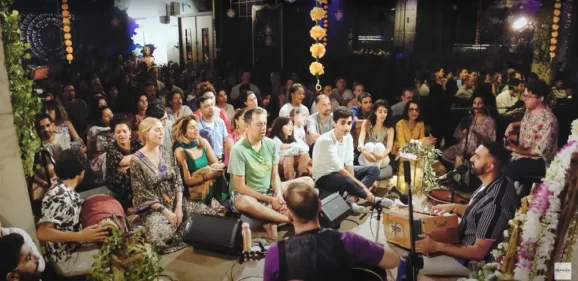
The practice of collective chanting—an electrifying communal experience—is said to bolster these benefits. The vibrational energy created by group chanting is believed to enhance the calming effects of the mantras, providing participants with a deeper sense of relaxation and inner peace.
Radhika Das is a London-based kirtan (chanting) artist who runs the mantra lounge at OmNom. He said: “The rise of mantra lounges reflects a growing need for people to reconnect with themselves and others through the power of sound and community.
“When I started the weekly kirtan nights at OmNom in Islington, we had just a handful of people coming together to chant. Now, with over 120 souls (at capacity) attending each week, it’s clear that mantra spaces provide something people are deeply yearning for—a sense of peace, unity, and spiritual elevation in an otherwise chaotic world.”
Radhika, who also holds kirtan residences in New York and organises retreats worldwide, added: “The magic of collective chanting is transformative and speaks to our shared human experience.
“But don’t have to be a spiritual person to enjoy it. The beauty of the Hare Krishna chant is that it works for anyone, whether you’re here to meditate deeply or just unwind after a long day.”

Author Andrew Horn, the son of the great neuroscientist Sir Gabriel Horn and grandson of the socialist peer Baron Soper, is widely regarded as one of the world’s leading experts on traditional Indian and Sanskrit drama whose English translation of the epic 16th-Century Vidagdha Madhava by Rupa Goswami is considered the most accurate ever published. Despite his notable lineage, Andrew chose a different path, becoming a Hare Krishna monk for 20 years. During this time, he was given the name ‘Arjundas Adhikari’, signifying devotion to the hero Arjuna from the Mahabharata. He also appeared on Top of the Pops with Boy George for the singer’s 1991 hit, Bow Down Mister.