Watch: driverless electric lorry makes history with world’s first border crossing

John E. Kaye
- Published
- News, Technology
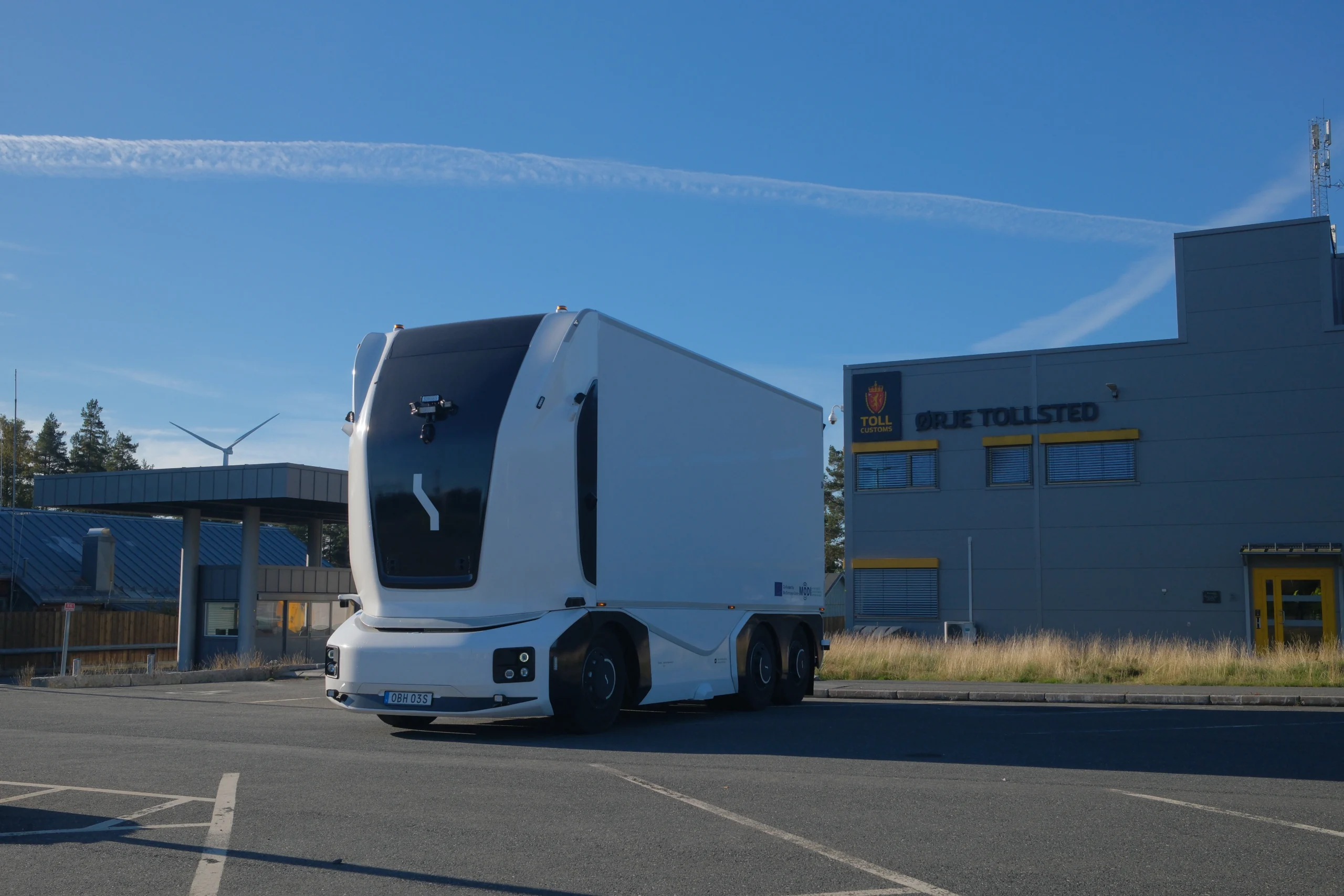
A cabless electric lorry, dubbed a “space-age milk float”, has become the first driverless vehicle in the world to cross an international border and clear customs entirely on its own
A driverless electric lorry has become the first of its kind to cross a national border, after making a fully autonomous delivery from Sweden into Norway.
The crossing, carried out at Ørje on behalf of logistics group PostNord, marks a world-first for a cabless electric vehicle operating without a human driver.
Customs clearance was completed without a driver on board, using cooperative technology developed with Norwegian firm Q-Free. The system linked the vehicle to Norway’s Digitoll digital customs platform, allowing goods to be declared in advance and the crossing to proceed seamlessly.
The trial, part of the EU co-funded MODI project, is designed to test how autonomous transport can be safely rolled out across Europe.
Cross-border operations are considered one of the biggest hurdles for autonomous freight because of differing national regulations, inconsistent road signage and complex border procedures. Norway’s customs authority, Tolletaten, backed the project, calling it highly relevant to the future of international freight.
Henrik Green, Chief Technology Officer and General Manager for Einride Autonomous Technologies, said: “We are immensely proud to have completed the world’s first cabless, electric, fully autonomous cross-border delivery. We are dedicated to continuously extending our capabilities into new applications, showcasing how autonomous technology can enhance transportation safety, efficiency, and sustainability. The MODI project perfectly embodies this commitment, assisting in the realisation of EU value-based objectives by thoughtfully balancing safety with innovation.”
The lorry forms part of a broader package of autonomous technology developed by Einride, the Swedish company behind the project. Its system combines the Einride Driver autonomous software stack, a purpose-built cabless vehicle, and a remote “Control Tower” platform that allows fleets to be monitored and managed off-site.
The company says the technology is designed to improve safety, efficiency and sustainability in heavy road freight.
The MODI project brings together public and private partners from Sweden and Norway, including Statens Vegvesen, Sintef, Q-Free, Trafikverket and Østfold kommune.
PostNord, which handles almost 200 million parcels a year across the Nordic region, said the trial underlined how automation could change logistics. May-Kristin S. Willoch, the company’s Head of Environment, said: “Taking part in this historic milestone demonstrates how autonomous and digital technologies can reshape the future of transport, reduce emissions, and improve safety. This achievement is not just about crossing a border – it’s about entering a new era for the logistics industry.”
READ MORE: ‘Dubai and Pony.ai unveil Robotaxi partnership as autonomous mobility plans accelerate’. The Dubai Roads and Transport Authority (RTA) and Chinese autonomous vehicle company Pony.ai have officially unveiled their joint robotaxi programme, marking a significant step forward in the city’s ambition to convert 25% of all journeys to autonomous transport by 2030
Do you have news to share or expertise to contribute? The European welcomes insights from business leaders and sector specialists. Get in touch with our editorial team to find out more.
TOP STORIES
-
 British buyers fuel Greek luxury property boom after non-dom tax change
 -
 New York named world’s most attractive city for tourists
 -
Saab lands German frigate deal after Poland submarine order
-
Students unveil world’s first solar-powered ambulance
-
Burnham told to tackle Britain’s cyber weak spots on day one
-
Doctors using AI before health systems set the rules
-
Humanoid robots could become the next K-pop stars
-
Hormuz flashpoint keeps global shipping on high alert
-
Scientists to gather in Lisbon to tackle next pandemic threats
-
Burnham warned digital exclusion is now a national security risk
-
Masts from Kent ‘doomsday wreck’ to be cut to prevent catastrophic explosion
-
GigaCloud and Cubbit launch sovereign cloud storage for Ukraine and Poland
-
Tributes paid to ‘forthright and fearless’ Ann Widdecombe
-
Boeing to debut Ghost Bat drone at Farnborough Airshow
-
Reeves opens ‘£2bn lifeline’ for small firms
-
Babymoon boom: Rhodes crowned 2026's top pre-baby escape as Salcombe leads UK getaway list
-
Xavier Niel to become Vodafone’s largest shareholder in £4.4bn deal
-
Two-thirds of lawyers say strong legal claims are dropped because of cost
-
UK government must "think again" about small business plan
-
Lockheed Martin pushes European missile expansion at NATO summit
-
Britain's new homes face 2050s heat test as experts warn of overheating crisis
-
Sky agrees £1.6bn deal to buy ITV’s broadcasting and streaming arm
-
Scientists crack dinosaur egg mystery by building life-size nest
-
Nobel laureate Omar Yaghi launches global science network
-
Cardiff drivers safest in Britain as London comes last