Europe and UK lag behind in global giving as low-income nations lead

John E. Kaye
- Published
- News
The Charities Aid Foundation’s World Giving Report 2025, published today, shows Europe and the UK near the bottom of global generosity rankings, with donations trailing far behind those in Africa and low-income countries
Europeans donate a smaller share of their income to good causes than those in almost every other part of the world, new research has found.
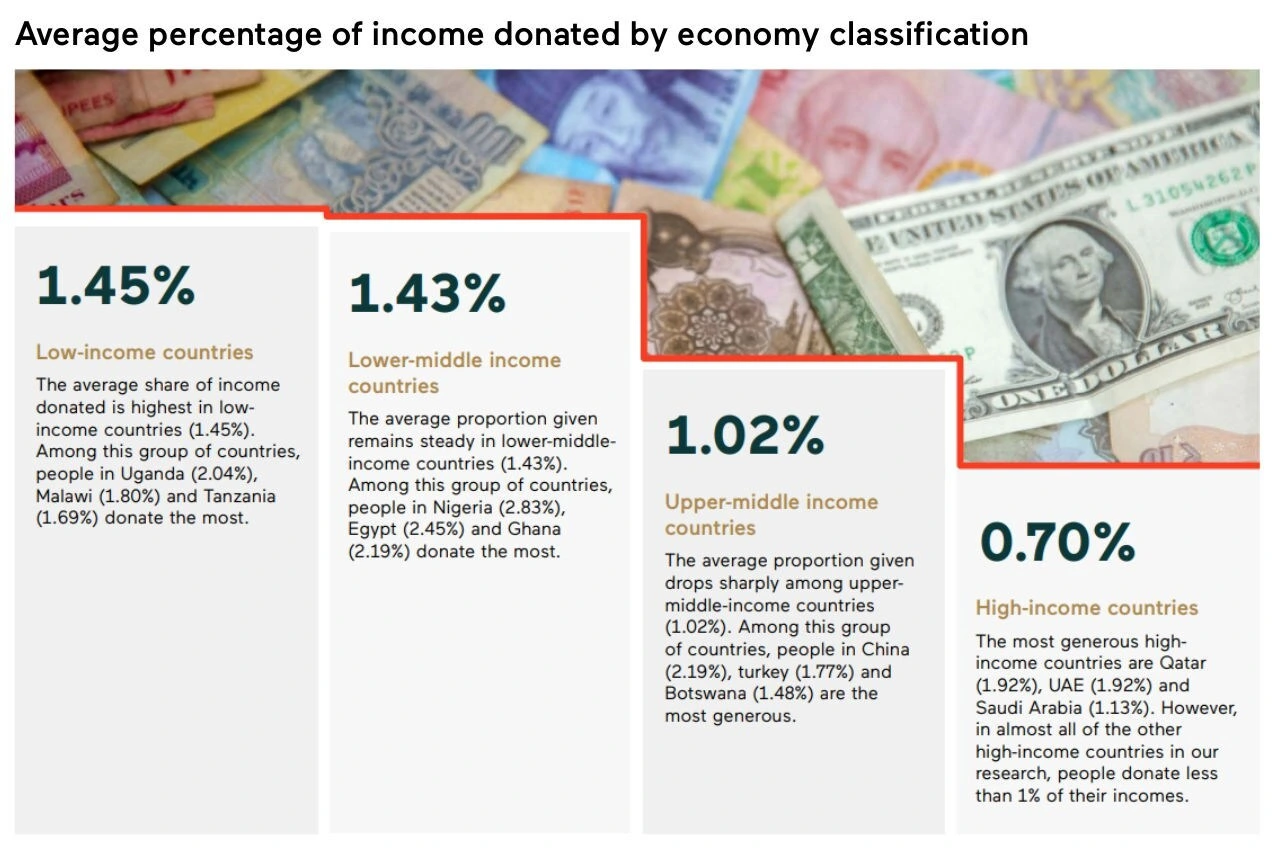
The Charities Aid Foundation’s (CAF) World Giving Report 2025 reveals that people in Europe donate an average of 0.64% of their income, which is less than half the average of 1.45% recorded in low-income countries.
Its report analyses donations as a proportion of income, offering a direct comparison of generosity between countries with different income levels.
Africa is the most generous continent, with an average of 1.54% of income donated to charitable, religious or humanitarian causes. By contrast, high-income countries, which include the UK, average just 0.7%.
Nigeria ranks as the single most generous nation in the study, with donations equivalent to 2.83% of income.
In comparison, France (0.45%) and Germany (0.39%) donate among the smallest shares of income globally, while Japan (0.16%) has the lowest proportion of all 101 countries surveyed.
The research is based on responses from more than 50,000 people worldwide. It shows that the most commonly supported cause across every continent is children and young people, with 29% of donors contributing to such initiatives.
Humanitarian aid and disaster relief is backed by 26% of people globally, while in Asia 16% of donors prioritise environmental causes.
CAF’s findings also show significant variation between age groups. Those aged 35 to 44 donate 1.18% of their income on average, compared with 0.83% among people over 65. Donors are most often motivated by a personal connection to a cause (65%), while 18% are influenced by news reports and 14% by social media. Local charities are the most trusted, followed by national and international organisations.
Neil Heslop, Chief Executive of CAF, said: “Around the world, social purpose organisations are facing severe financial headwinds. Traditional funding models need to change as patterns of behaviour evolve and governments cut back on their aid and development spending with philanthropy seeking to respond.
“Individual giving remains the cornerstone of generosity. Yet there is wide disparity, with the most dynamic cultures of giving often in countries where the populations are also much in need.
“It is notable that giving does not necessarily correlate with wealth or even security, but rather on the perception of necessity – and very often we perceive those closest to us to be most in need.”
The report, released today, also looks at the different ways people give. Globally, 38% of people give directly to families or individuals in need, 36% donate to charities, and 25% make donations for religious purposes. In terms of the value of donations, 40% goes directly to individuals, 36% to charities and 24% to religious organisations.
Europe’s giving levels are among the lowest across all continents, both in terms of participation and income share.
While 72% of people in Africa reported giving money in 2024, the equivalent figure for Europe is 59%. Among low-income nations, Uganda (2.04%), Malawi (1.80%) and Tanzania (1.69%) are the most generous.
In lower-middle-income countries, Nigeria leads with 2.83%, followed by Egypt (2.45%) and Ghana (2.19%). Among high-income countries, Qatar (1.92%) and the UAE (1.92%) are the most generous, with their levels far above those of most European countries.
The report highlights the influence of social norms on giving. In countries where cultural or religious expectations to give are strong, the average share of income donated is 1.61%. Where such social norms are weaker, the average falls to 0.56%.
Volunteering is also measured. Only 26% of people globally volunteered in 2024, with Europe contributing the lowest average of 6 hours 30 minutes per person compared to 14 hours 30 minutes in Africa.
“During these challenging times, there is much we can learn about the power of connection, and the nature of compassion for our fellow citizens, whether they be across the street or around the world,” Heslop added.
Main image: The average share of income donated to good causes by economy classification, CAF World Giving Report 2025. Photo: CAF
TOP STORIES
-
 British buyers fuel Greek luxury property boom after non-dom tax change
 -
 New York named world’s most attractive city for tourists
 -
Saab lands German frigate deal after Poland submarine order
-
Students unveil world’s first solar-powered ambulance
-
Burnham told to tackle Britain’s cyber weak spots on day one
-
Doctors using AI before health systems set the rules
-
Humanoid robots could become the next K-pop stars
-
Hormuz flashpoint keeps global shipping on high alert
-
Scientists to gather in Lisbon to tackle next pandemic threats
-
Burnham warned digital exclusion is now a national security risk
-
Masts from Kent ‘doomsday wreck’ to be cut to prevent catastrophic explosion
-
GigaCloud and Cubbit launch sovereign cloud storage for Ukraine and Poland
-
Tributes paid to ‘forthright and fearless’ Ann Widdecombe
-
Boeing to debut Ghost Bat drone at Farnborough Airshow
-
Reeves opens ‘£2bn lifeline’ for small firms
-
Babymoon boom: Rhodes crowned 2026's top pre-baby escape as Salcombe leads UK getaway list
-
Xavier Niel to become Vodafone’s largest shareholder in £4.4bn deal
-
Two-thirds of lawyers say strong legal claims are dropped because of cost
-
UK government must "think again" about small business plan
-
Lockheed Martin pushes European missile expansion at NATO summit
-
Britain's new homes face 2050s heat test as experts warn of overheating crisis
-
Sky agrees £1.6bn deal to buy ITV’s broadcasting and streaming arm
-
Scientists crack dinosaur egg mystery by building life-size nest
-
Nobel laureate Omar Yaghi launches global science network
-
Cardiff drivers safest in Britain as London comes last