‘Lost’ zip design could give space exploration a lift

John E. Kaye
- Published
- News, Technology
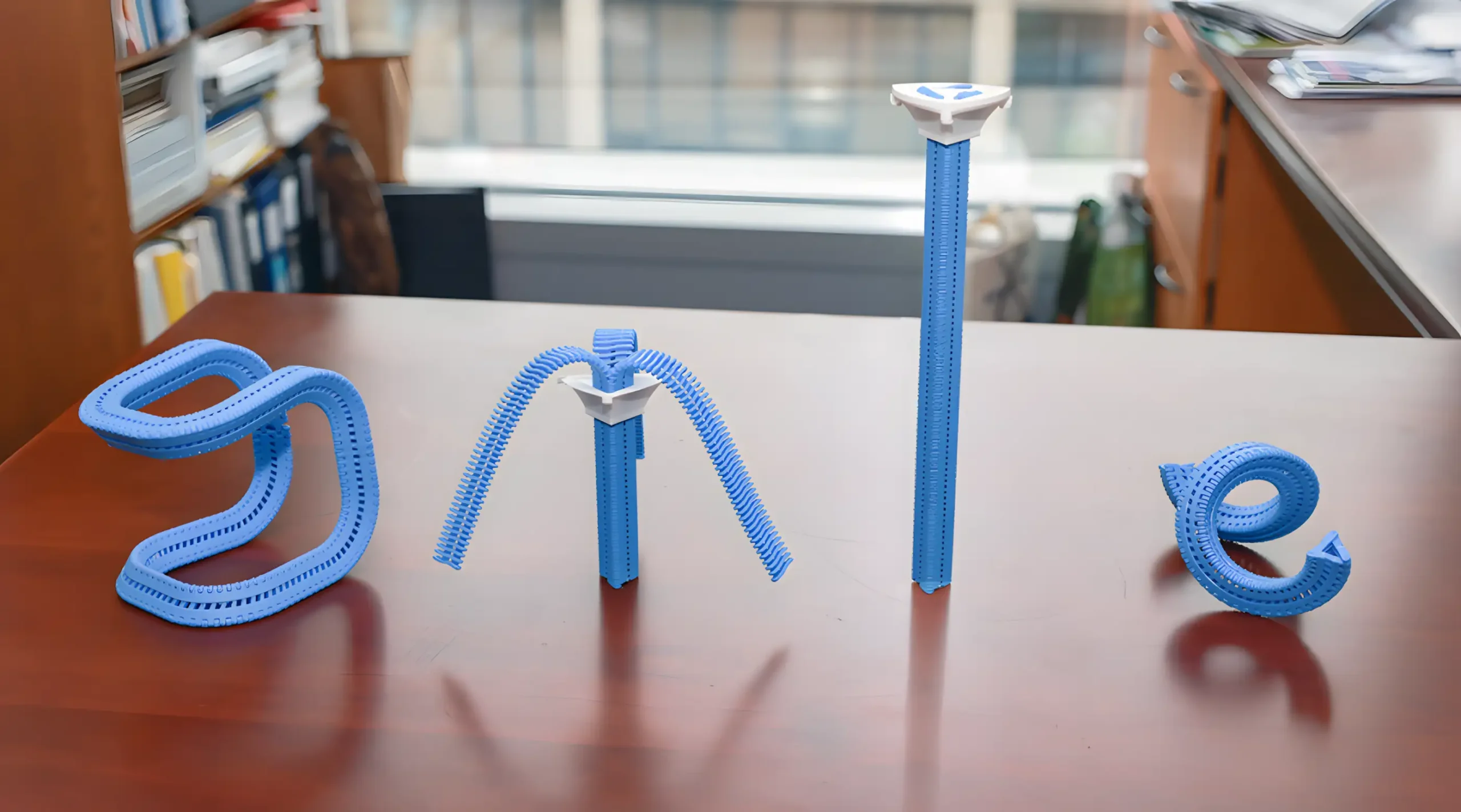
MIT researchers have revived a rejected three-sided zip design first proposed four decades ago, creating a fastener that can turn flexible strips into strong structures for possible use in spacecraft, robotics, tents and medical supports
A forgotten zip design from 40 years ago could one day help transform space exploration after MIT researchers brought the abandoned concept to life.
Researchers say their new three-sided fastener could help spacecraft grab rock samples, while also opening up possible uses in tents, robots and medical supports back on Earth.
The design, known as the ‘Y-zipper’, allows flexible strips to lock into a load-bearing form in seconds.
Unlike an ordinary zip, which fastens two sides together, the Y-zipper locks three separate strips into a triangular structure that can support weight and hold together under pressure.
The concept was first put forward 40 years ago by William Freeman, now an MIT professor, who patented the design and stored the prototype in his garage after the original proposal was rejected.
Experts have now revived the Y-zipper using 3D printing and digital design tools, turning the old concept into a working device that can be opened and closed by hand or using motorised actuation.
According to MIT, the design has already been used in prototypes including tent frames that can be packed flat and zipped into place, a wrist support that can be loosened during the day and tightened at night, a quadruped robot with adjustable leg height, and a kinetic flower installation that “bloomed” as the structure closed.
In one test, a tent that would normally take up to six minutes to pitch alone could be put up in 1 minute 20 seconds using the Y-zipper.
But researchers say the device – which withstood 18,000 cycles of opening and closing in tests before finally snapping – could also be used in space.
Its three separate sides could act like “tentacles”, reaching around an object before closing together.
Once zipped, those three sides would lock into a stronger form that could help grip, support or secure nearby rock samples.
MIT researcher Jiaji Li said: “A regular zipper is great for closing up flat objects, like a jacket, but Freeman ideated something more dynamic. Using current fabrication technology, his mechanism can transform more complex items.
“We’ve developed a process that builds objects you can rapidly shift from flexible to rigid, and you can be confident they’ll work in the real world.”
The work was published in the proceedings of the 2026 CHI Conference on Human Factors in Computing Systems in a paper by Jiaji Li, Xiang Chang, Mingming Li, Dingning Cao, Maxine Perroni-Scharf, Jeremy Mrzyglocki, Takumi Yamamoto, William Freeman and Stefanie Mueller.
READ MORE: Breitling launches £9,500 Artemis II watch as Moon crew returns to Earth. The luxury watchmaker has released a 450-piece Cosmonaute edition to mark NASA’s record-setting Artemis II mission, which ended with a Pacific splashdown on Friday after the first crewed journey around the Moon in more than 50 years.
Do you have news to share or expertise to contribute? The European welcomes insights from business leaders and sector specialists. Get in touch with our editorial team to find out more.
Main image: A prototype of MIT’s Y-zipper, a three-sided fastener that can turn flexible strips into load-bearing structures. Credit: MIT.
TOP STORIES
-
 British buyers fuel Greek luxury property boom after non-dom tax change
 -
 New York named world’s most attractive city for tourists
 -
Saab lands German frigate deal after Poland submarine order
-
Students unveil world’s first solar-powered ambulance
-
Burnham told to tackle Britain’s cyber weak spots on day one
-
Doctors using AI before health systems set the rules
-
Humanoid robots could become the next K-pop stars
-
Hormuz flashpoint keeps global shipping on high alert
-
Scientists to gather in Lisbon to tackle next pandemic threats
-
Burnham warned digital exclusion is now a national security risk
-
Masts from Kent ‘doomsday wreck’ to be cut to prevent catastrophic explosion
-
GigaCloud and Cubbit launch sovereign cloud storage for Ukraine and Poland
-
Tributes paid to ‘forthright and fearless’ Ann Widdecombe
-
Boeing to debut Ghost Bat drone at Farnborough Airshow
-
Reeves opens ‘£2bn lifeline’ for small firms
-
Babymoon boom: Rhodes crowned 2026's top pre-baby escape as Salcombe leads UK getaway list
-
Xavier Niel to become Vodafone’s largest shareholder in £4.4bn deal
-
Two-thirds of lawyers say strong legal claims are dropped because of cost
-
UK government must "think again" about small business plan
-
Lockheed Martin pushes European missile expansion at NATO summit
-
Britain's new homes face 2050s heat test as experts warn of overheating crisis
-
Sky agrees £1.6bn deal to buy ITV’s broadcasting and streaming arm
-
Scientists crack dinosaur egg mystery by building life-size nest
-
Nobel laureate Omar Yaghi launches global science network
-
Cardiff drivers safest in Britain as London comes last