Coming to a shoe spore near you: the world’s first mushroom-made trainers

John E. Kaye
- Published
- News, Sustainability
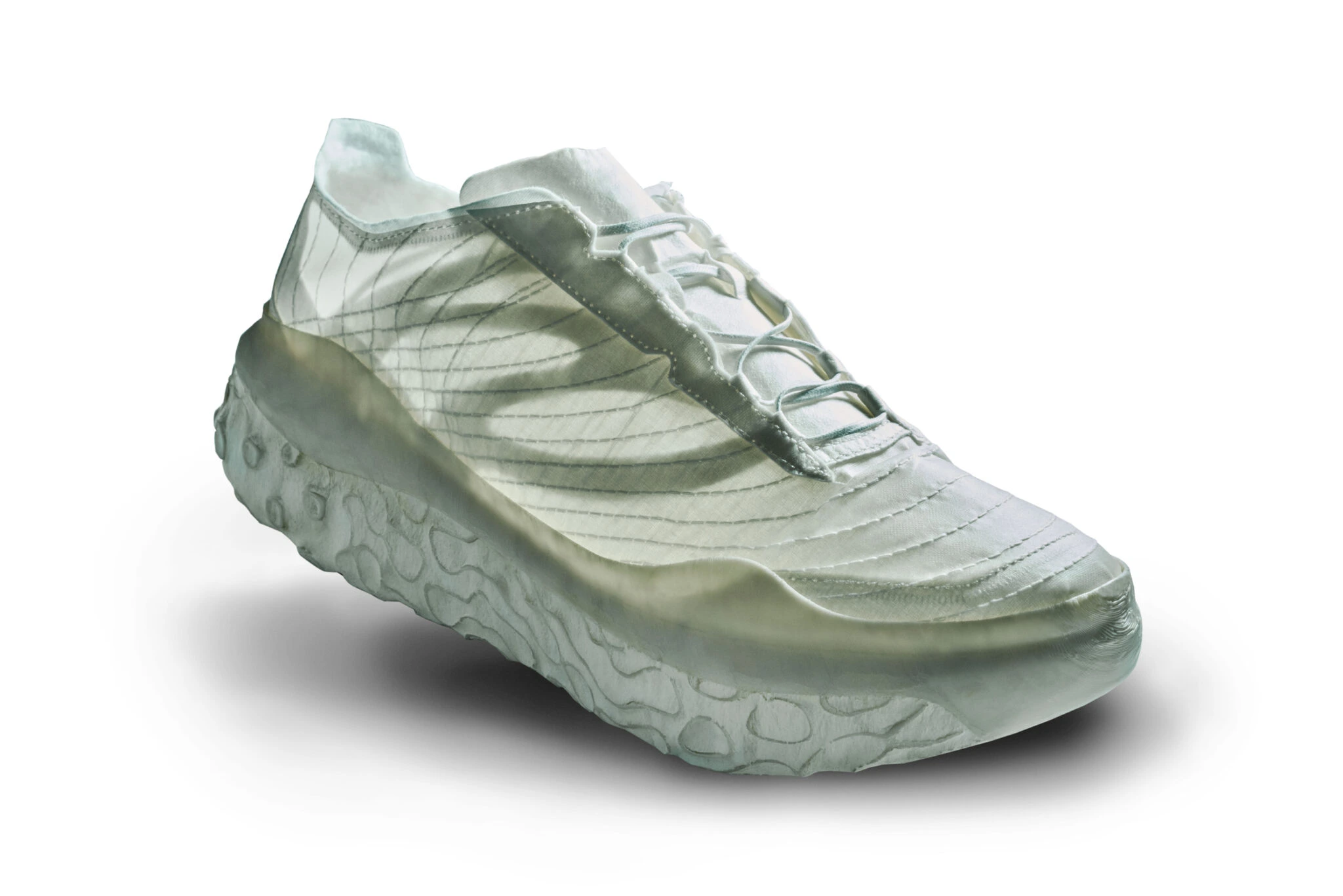
Made without plastics, foam or fossil fuels, this prototype trainer uses only five biodegradable materials — including a sole grown from fungi in just seven days
The world’s most environmentally friendly trainers have taken root in London – with soles made from mushrooms.
Unlike most trainers, the “groundbreaking” shoes are made entirely from natural and biodegradable materials, including fungi, lab-grown bacteria and plant-based fibres.
Their soles are formed from mycelium, the root-like structure of mushrooms, which is cultivated using solid state fermentation and grown around a PHA scaffold in just seven days.
The rest of the shoe is built from bacterial nanocellulose – a strong, flexible material produced through fermentation – while the laces and lining are made from cotton and lyocell.
The design, created by the Korvaa Consortium – a collaboration of biomaterial innovators, designers and filmmakers – is intended as a proof of concept to show how complex consumer products can be made without fossil fuels or synthetic inputs.
Traditional trainers can contain more than 30 materials, many of them petroleum-based. But the Korvaa design uses just five – all selected for their biodegradability, renewability or compostability.
It was unveiled this week at the Future Fabrics Expo in London.
Jen Keane, CEO and co-founder of Modern Synthesis, which developed the shoe’s upper, said the design shows how biologically grown materials could shape the future of footwear, offering new creative and manufacturing possibilities that go beyond traditional methods.
“By combining materials the way nature does – not by adding more, but by choosing better – we’re creating radical design possibilities for the industry.
“This unlocks unparalleled creative freedom, introducing novel functionalities and forms that simply couldn’t be achieved through conventional means.
“We’ve developed an artefact that is a tangible blueprint for the future of manufacturing.”
The shoe’s sole was developed by Ecovative, a U.S. company specialising in mushroom-based materials. Using solid state fermentation, the firm grows mycelium – the fibrous root system of fungi – through a scaffold made from polyhydroxyalkanoates (PHAs), a bio-based and biodegradable polyester.
The result is a sole grown in just seven days without synthetic foams, plastics or chemical processing.
The PHA scaffold was developed by Ourobio, a company that uses microbes to produce PHAs. It 3D-printed the base structure of the shoe, replacing conventional petroleum-derived materials such as EVA foam.
The upper was created by Modern Synthesis, a UK-based company using bacterial nanocellulose – a byproduct of fermentation – which it transforms into textile and coating materials. The result is a strong, lightweight alternative to leather or mesh.
The shoe was constructed using traditional string-lasting techniques by footwear specialists. The laces and internal lining were made from cotton and lyocell.
“This shoe demonstrates what becomes possible when three distinct biological processes work together,” Eben Bayer, co-founder and CEO of Ecovative, said.
“Each material was chosen for what it does best – and together they show that biology can manufacture complex products that traditionally require dozens of synthetic inputs.
“Collaboration like this is how we grow the material support system for a planet that works in harmony with humans.”
The project is being documented in Planet of the Microbes, a feature-length film by Finnish science communication studio Photino, which has followed the collaboration from the beginning. The documentary is expected to premiere at a leading film festival later this year.
The Korvaa Consortium is now encouraging other brands to explore similar biomaterial collaborations, positioning the shoe as a blueprint for sustainable design across the industry.
Nina Pulkkis, Documentary and Production Lead at Photino, added: “The first step is developing the technology, the second step is getting the story out there.
“Documenting this project from the beginning reveals the immense potential that arises when we align nature’s intelligence with human innovation – this is the kind of collaboration that makes you want to be part of the change.”
Main image: Korvaa Consortium
TOP STORIES
-
 British buyers fuel Greek luxury property boom after non-dom tax change
 -
 New York named world’s most attractive city for tourists
 -
Saab lands German frigate deal after Poland submarine order
-
Students unveil world’s first solar-powered ambulance
-
Burnham told to tackle Britain’s cyber weak spots on day one
-
Doctors using AI before health systems set the rules
-
Humanoid robots could become the next K-pop stars
-
Hormuz flashpoint keeps global shipping on high alert
-
Scientists to gather in Lisbon to tackle next pandemic threats
-
Burnham warned digital exclusion is now a national security risk
-
Masts from Kent ‘doomsday wreck’ to be cut to prevent catastrophic explosion
-
GigaCloud and Cubbit launch sovereign cloud storage for Ukraine and Poland
-
Tributes paid to ‘forthright and fearless’ Ann Widdecombe
-
Boeing to debut Ghost Bat drone at Farnborough Airshow
-
Reeves opens ‘£2bn lifeline’ for small firms
-
Babymoon boom: Rhodes crowned 2026's top pre-baby escape as Salcombe leads UK getaway list
-
Xavier Niel to become Vodafone’s largest shareholder in £4.4bn deal
-
Two-thirds of lawyers say strong legal claims are dropped because of cost
-
UK government must "think again" about small business plan
-
Lockheed Martin pushes European missile expansion at NATO summit
-
Britain's new homes face 2050s heat test as experts warn of overheating crisis
-
Sky agrees £1.6bn deal to buy ITV’s broadcasting and streaming arm
-
Scientists crack dinosaur egg mystery by building life-size nest
-
Nobel laureate Omar Yaghi launches global science network
-
Cardiff drivers safest in Britain as London comes last