ISF warns of a ‘corporate model’ of cybercrime as criminals outpace business defences

John E. Kaye
- Published
- Technology, Videos
Cybercrime has matured into an industry that mirrors legitimate enterprise, complete with supply chains and customer service. The industrialisation of hacking, amplified by artificial intelligence, demands a total rethink of how organisations manage people, technology and risk, warns Steve Durbin of the Information Security Forum
Cybercrime has evolved into a global industry that mirrors the corporate world it targets, with criminal groups now operating supply chains, 24/7 customer support and even refund policies, according to the Information Security Forum (ISF).
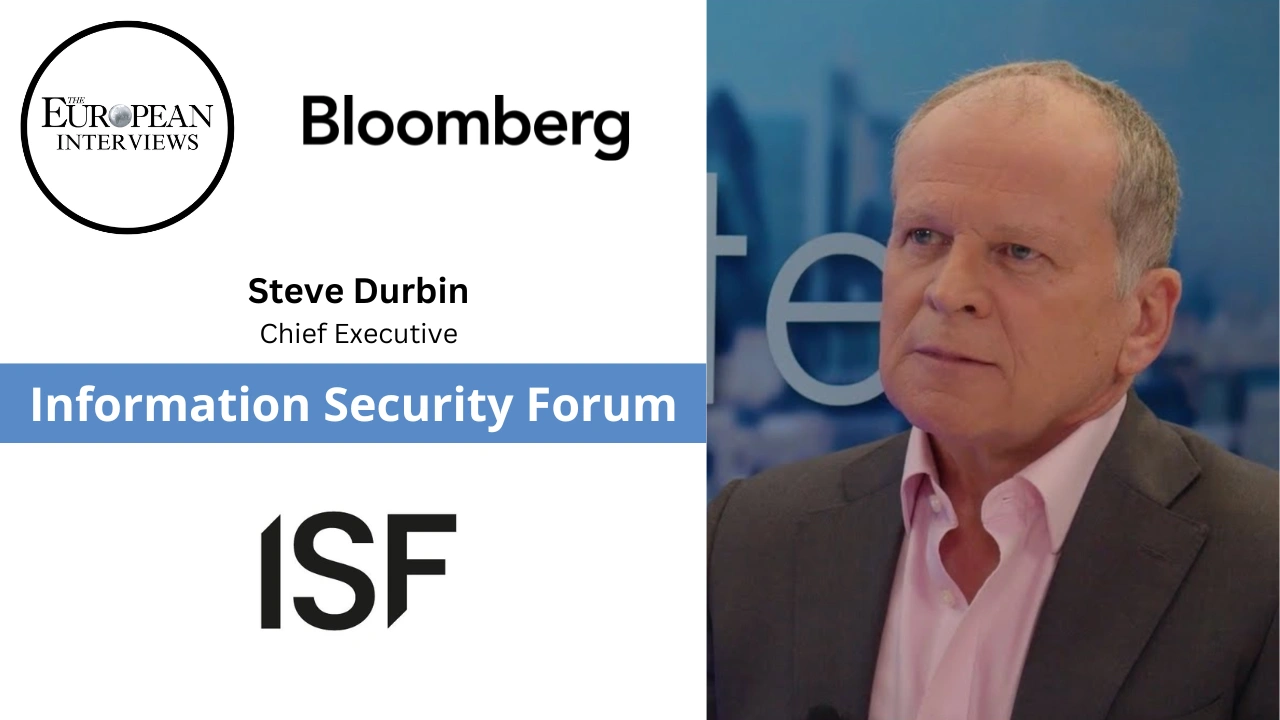
In an exclusive interview for Bloomberg TV, Steve Durbin, its chief executive, warned that cyberattacks have become “industrialised,” run by structured networks that invest in research, recruit technical specialists and sell malicious tools to other criminals as subscription services.
The result, he said, is a thriving underground economy that continues to out-innovate legitimate enterprises.
Speaking to The European’s Juliette Foster, Durbin said the growing professionalisation of cybercriminals had redefined the global threat landscape.
Groups that once focused on stealing data for profit are now manipulating information to undermine decision-making and product quality, a tactic that can erode competitiveness long before a breach is detected.
Increasingly, attacks are carefully designed to exploit the weakest link in a business ecosystem, often through smaller suppliers with less mature defences, he added.
The warning comes after cyberattacks surged to record levels this year, with global businesses facing an average of 1,925 attempted breaches each week — a 47 per cent rise on 2024 — according to data from Check Point Software.
In the UK, the scale of the threat was laid bare in May when Marks & Spencer disclosed that a “highly sophisticated and targeted” attack will reduce its operating profit by about £300 million.
Carmaker Jaguar Land Rover (JLR) was cripped by a cyber attack that left its production lines at a standstill since the start of September.
Output only resumed at some of its manufacturing sites this week.
“Cybercrime is now a very real and very large entrepreneurial industry, and the rise of Ai is only making things worse,” Durbin said.
“There are even organisations offering hacking services with around the clock help desks and guarantees – if what they’re offering doesn’t work, you get your money back.
“All of this means that the point of entry for a cybercriminal has lowered considerably, and this will only continue as Ai becomes more sophisticated.”
ISF’s recent project update found that large organisations are increasingly being compromised through their supply chains, where cybercriminals take advantage of limited oversight and inconsistent security standards.
The ISF, a global non-profit, is now urging corporations to extend their risk-management frameworks to include third-party partners and to share not only technical guidance but also the rationale behind security requirements, so that smaller firms understand their role in collective resilience.
Durbin added that the current wave of attacks highlights a deeper organisational problem. Too many companies, he argued, still treat cybersecurity as a specialist technical function rather than a strategic one.
The ISF believes security should be embedded within core business planning, reviewed on a rolling six-month cycle alongside financial and operational strategy, and supported by board-level education so that directors fully understand the risks they are accepting.
It is also calling for a cultural shift in how firms manage people and technology. It stresses that artificial intelligence, while vital for identifying threats at scale, is only as effective as the governance behind it.
Businesses must invest in training and workforce transformation to ensure employees can work effectively with AI-enabled systems, rather than relying on automation to replace human judgement, he said.
The ISF’s analysis also found that organisational silos are a major source of weakness, with fragmented departments — where sales, finance and technology functions operate in isolation — slowing incident responses and obscuring emerging vulnerabilities.
It recommends mapping interdependencies across business units to reveal where information gaps or duplicated processes could expose the organisation to risk.
At leadership level, companies must also address the talent shortage that continues to hamper the cybersecurity sector. Rigid entry criteria and narrow recruitment pipelines have restricted diversity of thought, leaving many vacancies unfilled, Durbin warned.
The ISF advises employers to look beyond traditional technical backgrounds, prioritising aptitude and curiosity, and to build partnerships with education providers to expand the skills base.
According to the ISF, regulation is failing to keep up with the speed of technological change, and reactive policy-making risks burdening businesses with compliance demands that do little to enhance security.
Instead, it argues for proportionate oversight built on the same risk-management principles that companies already apply to finance, reputation and safety.
Durbin said: “The bad guys only need to get lucky once and they can cause havoc. The sorts of numbers we’re seeing are those actors trying to break down defences and finding a way through. It means we have to be at the top of our game 24/7.”
Watch Steve Durbin’s full interview with Business Matters for Bloomberg TV on The European’s YouTube channel.
READ MORE: ‘Why cybersecurity deserves a place in the political spotlight‘. Cybersecurity may not win elections, but it’s fundamental to national security, economic stability, and public trust, argues Steve Durbin, Chief Executive of the Information Security Forum, who is calling on leaders to take proactive steps to protect their assets, strengthen resilience, and ensure secure deployment of emerging technologies.
Do you have news to share or expertise to contribute? The European welcomes insights from business leaders and sector specialists. Get in touch with our editorial team to find out more.
TOP STORIES
-
 British buyers fuel Greek luxury property boom after non-dom tax change
 -
 New York named world’s most attractive city for tourists
 -
Saab lands German frigate deal after Poland submarine order
-
Students unveil world’s first solar-powered ambulance
-
Burnham told to tackle Britain’s cyber weak spots on day one
-
Doctors using AI before health systems set the rules
-
Humanoid robots could become the next K-pop stars
-
Hormuz flashpoint keeps global shipping on high alert
-
Scientists to gather in Lisbon to tackle next pandemic threats
-
Burnham warned digital exclusion is now a national security risk
-
Masts from Kent ‘doomsday wreck’ to be cut to prevent catastrophic explosion
-
GigaCloud and Cubbit launch sovereign cloud storage for Ukraine and Poland
-
Tributes paid to ‘forthright and fearless’ Ann Widdecombe
-
Boeing to debut Ghost Bat drone at Farnborough Airshow
-
Reeves opens ‘£2bn lifeline’ for small firms
-
Babymoon boom: Rhodes crowned 2026's top pre-baby escape as Salcombe leads UK getaway list
-
Xavier Niel to become Vodafone’s largest shareholder in £4.4bn deal
-
Two-thirds of lawyers say strong legal claims are dropped because of cost
-
UK government must "think again" about small business plan
-
Lockheed Martin pushes European missile expansion at NATO summit
-
Britain's new homes face 2050s heat test as experts warn of overheating crisis
-
Sky agrees £1.6bn deal to buy ITV’s broadcasting and streaming arm
-
Scientists crack dinosaur egg mystery by building life-size nest
-
Nobel laureate Omar Yaghi launches global science network
-
Cardiff drivers safest in Britain as London comes last


















ISF warns of a ‘corporate model’ of cybercrime as criminals outpace business defences
John E. Kaye
- Published
- Technology, Videos
TOP STORIES
-
British buyers fuel Greek luxury property boom after non-dom tax change
-
New York named world’s most attractive city for tourists
-
Saab lands German frigate deal after Poland submarine order
-
Students unveil world’s first solar-powered ambulance
-
Burnham told to tackle Britain’s cyber weak spots on day one
-
Doctors using AI before health systems set the rules
-
Humanoid robots could become the next K-pop stars
-
Hormuz flashpoint keeps global shipping on high alert
-
Scientists to gather in Lisbon to tackle next pandemic threats
-
Burnham warned digital exclusion is now a national security risk
-
Masts from Kent ‘doomsday wreck’ to be cut to prevent catastrophic explosion
-
GigaCloud and Cubbit launch sovereign cloud storage for Ukraine and Poland
-
Tributes paid to ‘forthright and fearless’ Ann Widdecombe
-
Boeing to debut Ghost Bat drone at Farnborough Airshow
-
Reeves opens ‘£2bn lifeline’ for small firms
-
Babymoon boom: Rhodes crowned 2026's top pre-baby escape as Salcombe leads UK getaway list
-
Xavier Niel to become Vodafone’s largest shareholder in £4.4bn deal
-
Two-thirds of lawyers say strong legal claims are dropped because of cost
-
UK government must "think again" about small business plan
-
Lockheed Martin pushes European missile expansion at NATO summit
-
Britain's new homes face 2050s heat test as experts warn of overheating crisis
-
Sky agrees £1.6bn deal to buy ITV’s broadcasting and streaming arm
-
Scientists crack dinosaur egg mystery by building life-size nest
-
Nobel laureate Omar Yaghi launches global science network
-
Cardiff drivers safest in Britain as London comes last